Your Learnvia courseware has a table of contents like a textbook, with a few differences because the courseware is interactive. Here is how it is organized:
- Chapters
- Modules
- Tasks: Lesson, Homework, or Quiz
- Activities: things like answering a question, watching a video, or trying out a tool.
- Tasks: Lesson, Homework, or Quiz
- Modules
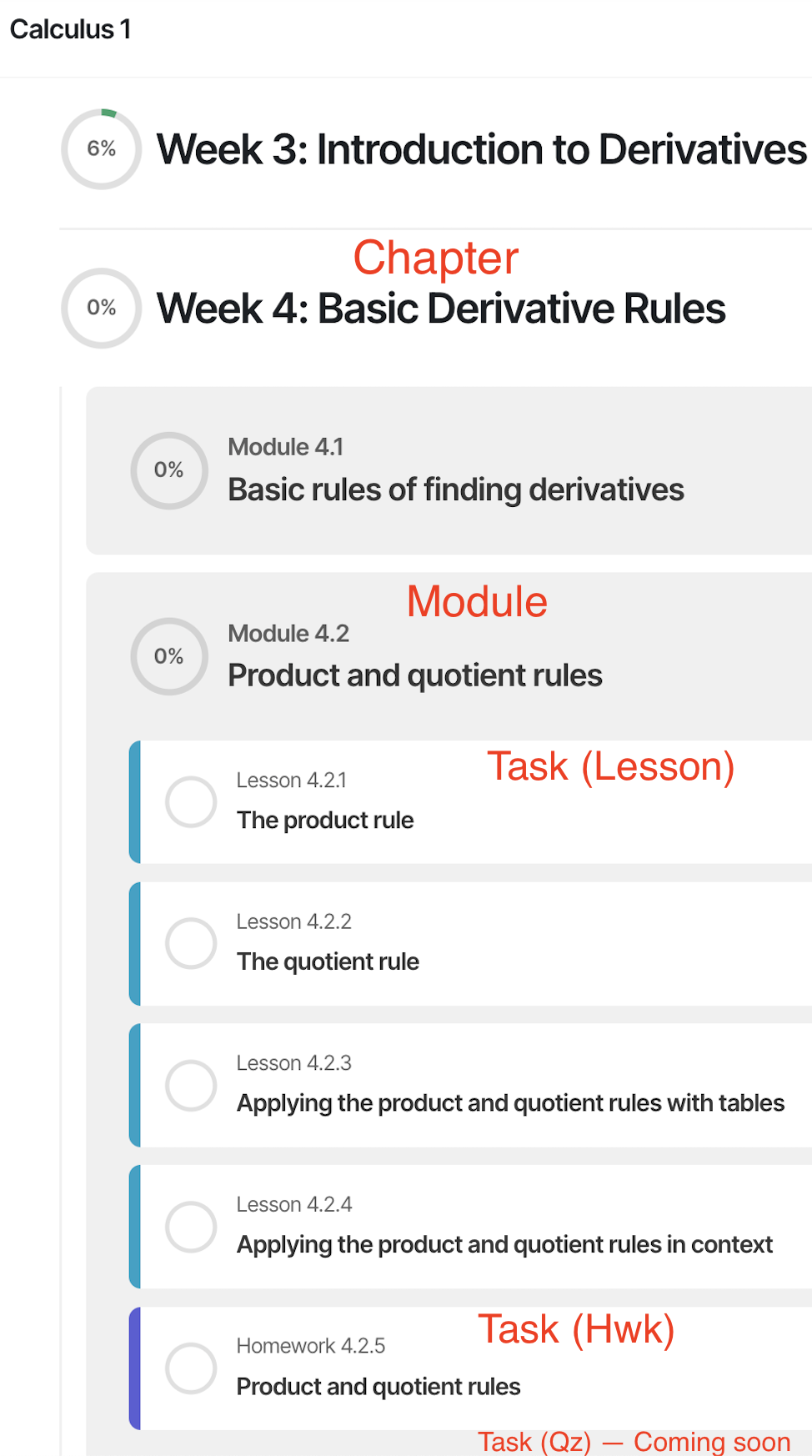
Chapters: Chapters are the big topics, just like in a textbook. For example, Calculus 1 covers: (1) Intro, (2) Limits, (3) Derivatives, (4) Applications of Derivatives, (5) Integrals. Your instructor can also set up the course so each chapter is a week. In that case, your chapters might look like: (1) WK1: Functions and Intro to Calculus, (2) WK2: Limits, (3) WK3: Intro to Derivatives, (4) Basic Derivative Rules, and so on through (13) Definite Integral and Fundamental Theorem, (14) Net Change Theorem and Substitution. When a course is set up this way, you can see at a glance what each week covers, and every week follows the same simple pattern.
Modules (1-1.5 hrs): Each chapter is made up of several modules. A module is like a "section" in a textbook. A topic-based chapter might have 10-15 modules, while a weekly chapter usually has 2-5. We call them modules to avoid mixing them up with a class section.
Tasks (10-15 min): Each module is made up of a series of tasks. A task is like a "subsection" in a textbook. We use the word task to make it clear the content is something you do. There are three types of tasks:
- Lessons: A lesson introduces a topic. It usually has a bit of text, a 1-2 minute video, and 10-20 learning questions that explore ideas, teach you calculations, and get you ready for homework.
- Homework: A homework usually has 10-20 questions. It gives you more practice with calculations, explores ideas further, and gets you ready for quizzes.
- Quizzes: A quiz usually has about 10-20 questions that check how well you understand the concepts and can do the calculations. Quiz questions are the kind you might see on quizzes, midterms, and final exams.
Each task is made up of small activities, like answering a question, and there are usually tens of activities per task. Each module and task in the table of contents shows how many activities are inside it. For example, 8 / 56 means you have finished 8 of the 56 activities.
The three task types work a little differently:
- Lessons give you hints, solutions, and explanations, which you can copy to answer the questions.
- Homeworks give you hints, solutions, and explanations too. But if you look at a solution before you answer correctly, a new question is created that you will need to answer correctly on your own.
- Quizzes do not give hints, solutions, or explanations while you take them. You simply answer each question. After you submit, you can see the solutions and explanations.
These task types follow three key learning-design ideas: chunking, scaffolding, and alignment.
- Chunking breaks learning into bite-size pieces [1]. This helps you learn, and it fits the short pockets of study time you often have. Every task is designed to take about 10-15 minutes.
- Scaffolding builds up your learning step by step, without any single step being too big [2]. The questions in a lesson build up gradually. Homework questions are a bit more challenging. Quizzes may include even harder problems.
- Alignment makes sure everything connects [3]. Lessons build toward homework, and homework builds toward quizzes. In fact, the courseware is built using an idea called backwards design: authors first decide the learning outcomes they want, then write final exam questions for those outcomes, then quiz questions that point to the exam questions, then homework questions that point to the quiz questions, and finally lessons that point to the homework questions. This is why your coursework is designed to prepare you for your exams.
[1] Humphries, B. and Clark, D., 2021. An examination of student preference for traditional didactic or chunking teaching strategies in an online learning environment. Research in Learning Technology, 29.
[2] Doo, M.Y., Bonk, C. and Heo, H., 2020. A meta-analysis of scaffolding effects in online learning in higher education. International Review of Research in Open and Distributed Learning, 21(3), pp.60-80.
[3] Biggs, J., 1996. Enhancing teaching through constructive alignment. Higher education, 32(3), pp.347-364.
For quick definitions of these terms, see the Glossary of Learnvia Terms.
Was this article helpful?
That’s Great!
Thank you for your feedback
Sorry! We couldn't be helpful
Thank you for your feedback
Feedback sent
We appreciate your effort and will try to fix the article